
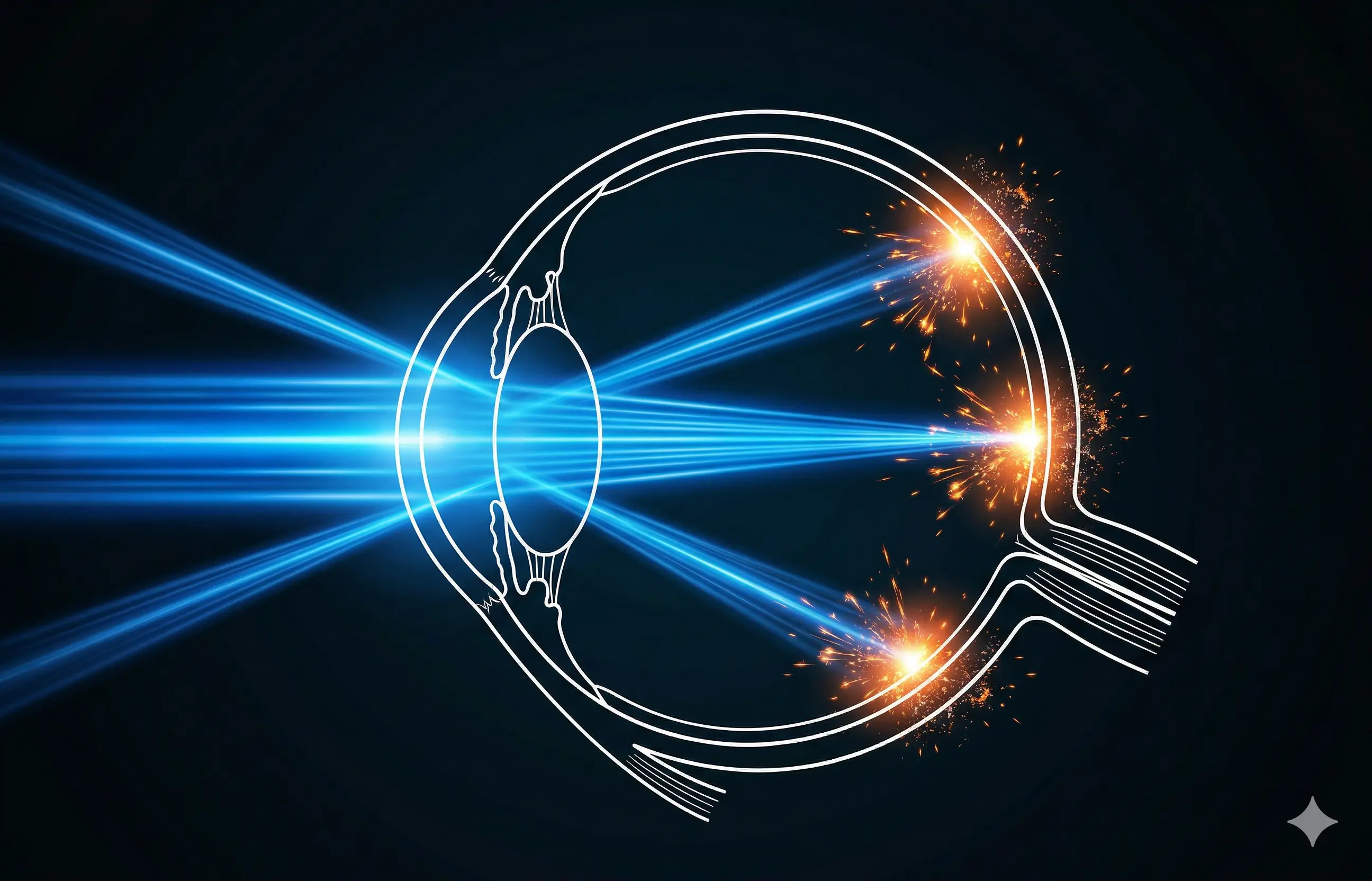
Most individuals attribute the early symptoms of visual decline to getting older or simply needing a new prescription. We are conditioned to treat the symptom — buying stronger reading glasses or relying on artificial tears — without addressing the underlying cellular mechanics.
However, ophthalmology researchers identify specific markers as direct indicators that the cellular repair cycle inside the eye is being overwhelmed. When the retinal stem cells and photoreceptors are subjected to chronic oxidative stress from screen radiation, they produce distinct warning signs.
Below are the 7 clinical signals that indicate your retina is experiencing cellular fatigue. Ignoring these signs allows the stress to progress toward permanent structural changes.
Sign 1: Morning Blurry Vision That Takes Minutes to Clear
Waking up with foggy vision that slowly clears is not just "sleep crust" or your eyes adjusting to the light. It is a sign that your eye's overnight repair cycle is failing.
A healthy retina utilizes stem cells during the night to clear the cellular debris accumulated from the previous day's screen exposure. When these cells are fatigued from excessive oxidative stress, the repair process is not completed by morning, leaving a buildup that manifests as slow-to-clear blurry vision.
Read the full clinical analysis on morning blurSign 2: Slow Focus Recovery After Using Your Phone
If you look up from a digital device and the room across from you remains out of focus for several seconds, your retinal cells are experiencing acute fatigue. This is not standard muscle strain; it is a delay in neurological and cellular processing.
This post-screen blur is an early indicator that your internal visual processing mechanisms are under significant strain, signaling that the photoreceptors are struggling to replenish the energy needed to shift focal planes.
Read the research on post-screen blurSign 3: Worsening Night Vision and Driving Glare
Struggling with oncoming headlights and seeing halos around streetlamps is caused by the fatigue of rod photoreceptor cells. Rods are the cells responsible for low-light vision and are highly vulnerable to oxidative damage.
Research shows that rod cell decline is one of the earliest measurable changes in the retina, often preceding central macular issues by years. This makes night vision decline a strong predictive marker for future overall retinal health.
Read why night vision decline is a critical warningSign 4: A Sudden Increase in Eye Floaters
Eye floaters are clumps of collagen fibers casting shadows on your retina. While a few are normal, a sudden increase indicates that the vitreous gel inside the eye is degrading faster than the body can manage.
This accelerated breakdown is directly linked to an environment of high oxidative stress and declining antioxidant defense. The same toxic environment that liquifies the vitreous also stresses the delicate retinal tissue directly behind it.
Read what the science says about sudden floatersSign 5: Chronic Dry, Burning Eyes That Drops Cannot Fix
If artificial tears only provide 20 minutes of relief, the issue is not just surface-level dryness. Continuous screen radiation disrupts the meibomian glands, causing severe tear film instability.
Relying on drops with chemical preservatives can eventually wash away your eye's natural lipid layer. Chronic burning requires internal cellular support to manage the micro-inflammation, not just external moisture applied to the surface.
Read the analysis on chronic burning eyesSign 6: A Dark or Distorted Spot in Your Central Vision
This is the most critical warning sign. A central scotoma (a blind or distorted spot in the center of your view) indicates that macular cells have failed to clear cellular waste, leading to the deterioration of the overlying photoreceptors.
The cells in the darkened area cannot be restored. However, the surrounding healthy cells (the penumbra zone) require immediate nutritional and antioxidant support to halt the expansion of the structural stress.
Read the urgent research on central dark spotsSign 7: Fading Peripheral Vision (Tunnel Vision)
Bumping into door frames, tripping over low objects, or missing cars in your side vision signifies severe stress on the optic nerve. The nerve fibers transmitting visual data to the brain are failing.
Protecting the remaining nerve fibers from oxidative damage and promoting healthy microcirculation is paramount when peripheral vision begins to fade. Once the nerve fibers die, the loss is permanent.
Read the full breakdown on peripheral vision lossIt is exceedingly rare for an individual to experience only one of these signs in isolation. Because they all stem from the same root cause — retinal cellular fatigue driven by oxidative stress — patients typically report experiencing two to three of these symptoms concurrently before seeking medical evaluation.
The Question You Must Ask Yourself Now
If you recognized two or more of these warning signs, your eye drops and new prescription glasses are only masking a much deeper problem.
These 7 symptoms are not isolated events. They are all expressions of the exact same underlying mechanism: the depletion of retinal stem cells and the failure of the eye's cellular repair cycle.
But what is actually destroying your retinal defense system at such an accelerated rate? And what did clinical researchers discover in a remote Nordic region that is helping thousands support their retinal health from the inside out?
Watch the Free Retinal Repair Discovery