Your Phone Is Quietly Stressing Your Vision — And the Blur You Feel Afterward Is the Proof
Most people call it "eye strain." Ophthalmology researchers describe it as an early sign of retinal stem cell fatigue — and it compounds over time.
Why Does Vision Get Blurry After Looking at a Screen?
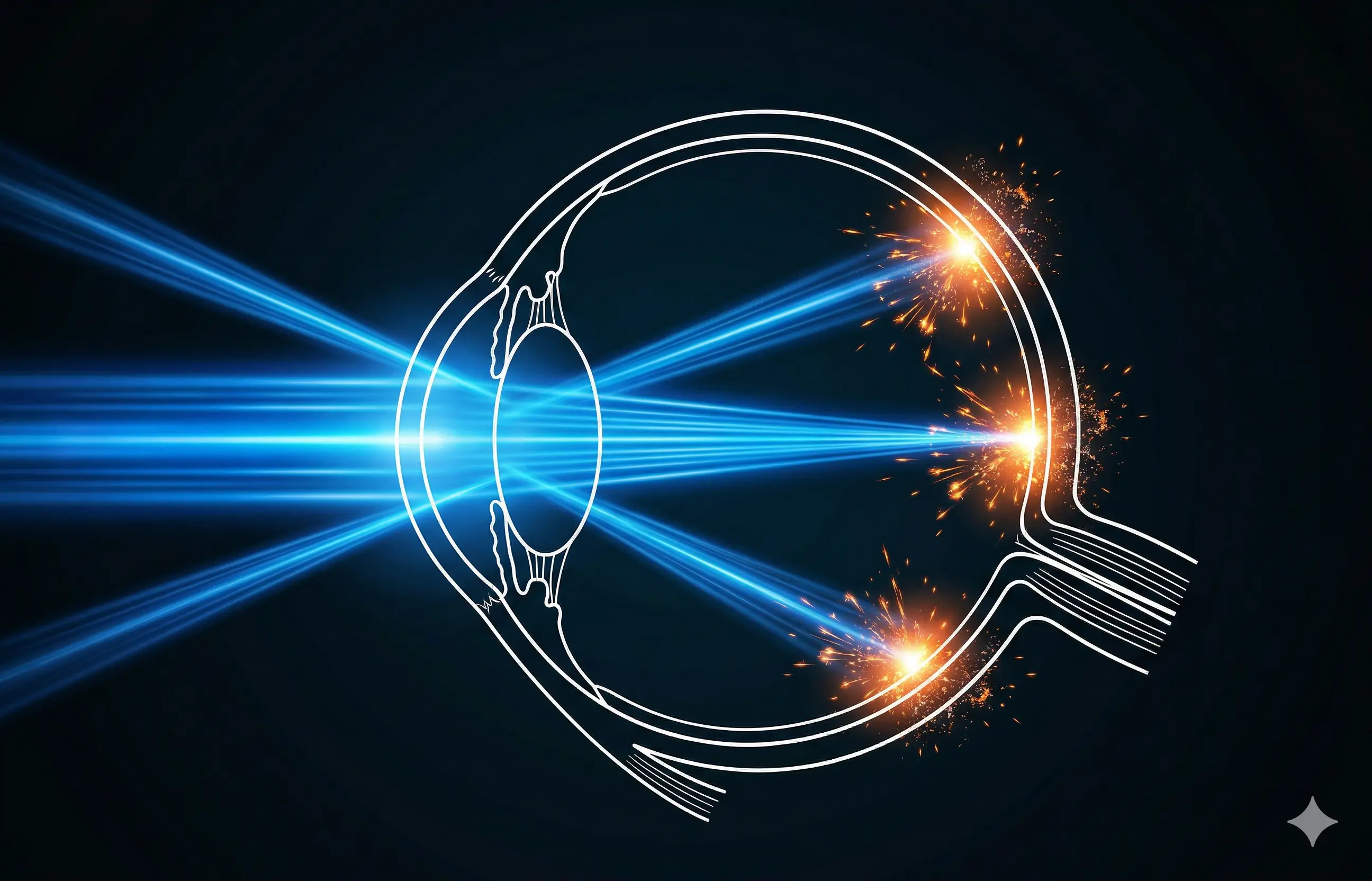
Post-screen blur happens because high-energy blue light emitted by phones and computers penetrates the retina, creating oxidative stress inside photoreceptor cells. When you stare at a screen for extended periods, the cellular debris generated outpaces your eye's natural ability to clear it. The temporary blur you experience is your retina struggling to run its cellular repair cycle, a process heavily dependent on specialized retinal stem cells.
 Reviewed by Dr. Ming Wang, MD · Ophthalmology Specialist
The 4 Stages of Screen-Induced Vision Fatigue
Researchers have mapped a predictable progression. Most people are somewhere in the middle — and don't realize it until Stage 3 or 4.

Eyes tire quickly on screens. Blur clears in under 60 seconds after looking away. Easy to dismiss.

Post-screen blur takes 3-5 minutes to clear. Headaches common. Stem cell repair is falling behind.

Blur lingers even after rest. Night vision worsens. Screen avoidance begins. Cellular stress is accumulating.

Prescription changes accelerate. Floaters increase. The stress is impacting long-term retinal integrity.
Warning Signs Your Retinal Stress Has Already Started
Most of these seem minor on their own. But researchers have identified them as early measurable signs that your retina's self-repair capacity is under pressure. Read the warning signs below:
Why "Just Take More Breaks" Doesn't Address the Root Cause
The standard advice — the 20-20-20 rule, screen time limits — addresses the immediate symptom. It does not actively support the cellular recovery process needed after exposure.
Research shows that blue-light wavelengths (415-455nm) generate reactive oxygen species (ROS) inside retinal cells. These ROS molecules impact the mitochondria of photoreceptor cells — the biological engine responsible for your vision.
Your retina has a built-in repair mechanism: retinal pigment epithelium (RPE) stem cells that manage cellular debris overnight. But this system has a biological limit. When screen exposure generates ROS faster than RPE cells can process them, a backlog builds up. Continuous daily exposure compound this fatigue.
Blue-light glasses block roughly 20-30% of incoming blue light. But your screen still emits a significant portion of the wavelengths causing cellular fatigue. For retinas with already-depleted reserves, passive blocking isn't a complete solution. It is the equivalent of holding an umbrella during a hurricane.
One of thousands reporting results through this discovery
Robert Spent 3 Years Blaming Eye Strain — Until He Addressed the Cellular Cause
Robert K. is a 64-year-old project manager. For the past decade, his job required 9-10 hours a day in front of screens. By his late 50s, he developed a daily ritual: finish a meeting, close his eyes for a few minutes, wait for the blur to clear.
"I just accepted it as part of the job. My eye doctor said it was 'digital eye strain' and gave me reading glasses. The glasses helped for about six months. Then I needed a stronger pair. I thought this was just how it went."
His turning point came after reading research regarding retinal stem cell fatigue — specifically, how free-radical stress contributes to both post-screen blur and long-term macular health.
"What changed everything for me wasn't the glasses. It was understanding that my retina needed specific targeted nutrients to run its own natural repair system."
After discovering a research-backed protocol featuring concentrated Nordic wild blueberry anthocyanins, Robert noticed that his post-screen recovery time improved significantly. Within a few months, he reported the constant background eye fatigue had vastly diminished.
Robert K. — 64, Project Manager
Why Nordic Wild Blueberries Support the Retina's Repair Cycle
Researchers studying specific populations noticed that individuals consuming diets rich in wild Nordic bilberries maintained sharper vision and faster visual recovery times, despite equivalent screen exposure to other groups.
The active botanical compounds — cyanidin-3-glucoside and delphinidin-3-glucoside — were shown to cross the blood-retinal barrier effectively. When compared to commercial blueberries, wild Nordic varieties contained significantly higher anthocyanin concentrations, matching the specific nutritional profile the retinal cells utilize during their overnight repair cycle.
A free presentation compiled by vision health researchers explains exactly how the Nordic blueberry discovery supports cellular recovery. It details why thousands of screen-heavy workers and retirees are incorporating it to support their macular health. The presentation covers the clinical findings and explains what to look for.